

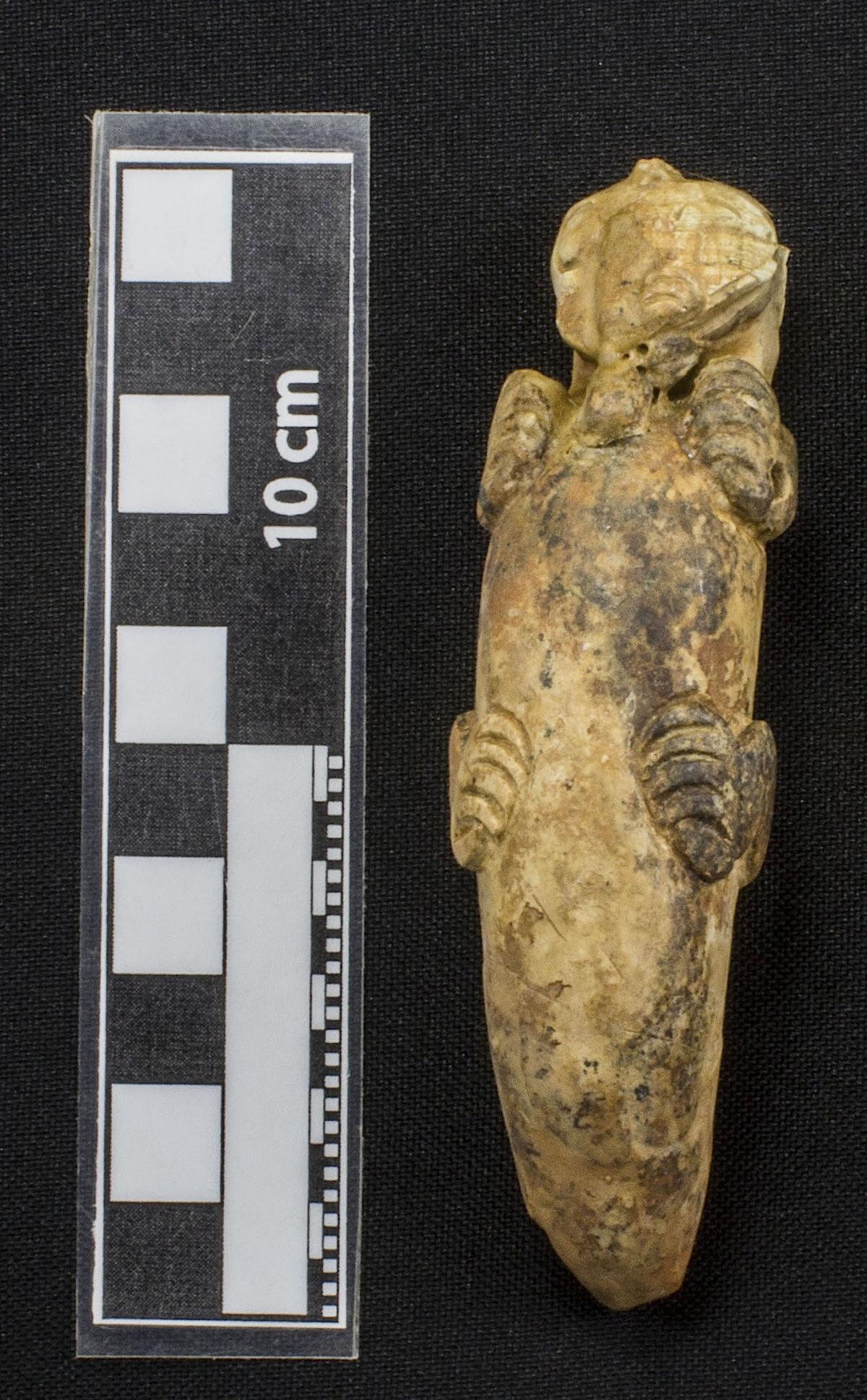

Digital Object 760
Description:
Bone carved into the shape of a mythical being, with the head of a feline with big round eyes and rounded ears, claws, and the body and tail of crocodile.
Conservation treatment:
At the time of documentation, the object had cracks, sediments, and loss of material especially in the area of the neck and extremities, and at the tip or tail. When removed from the excavation, measures were used to maintain the physical alignment of the object, and a kind of putty or temporary bridge was used to attach the head to the rest of the body. Prior to preservation treatment, the material binding the object at the neck lost adhesion, and the two areas were then treated separately. Care of the object was taken over by the curator Ainslie Harrison, who carried out the first phase of mechanical cleaning. In this phase, sediments were removed from both parts, first with a vacuum bulb and then mechanical cleaning with bamboo skewers. Ethanol and demineralised water (50:50) were used to remove stains. After the object was stripped of sediments, the surface cracks were consolidated with Paraloid B-72 diluted in acetone (6% concentration). Pipettes and syringes were used to apply the solution to the most delicate areas. Then we proceeded to assemble the object, attaching pieces that had originally been broken. B-72 was used in concentrations of 40% acetone in the damaged areas (claws, tail, etc.). For the head, joined to the body by a yellow putty, a mixture of "microbubbles" and B-72 was prepared. Natural pigment powder for the color integration phase was then added to this paste. A color that did not fully match that of the original object was used in order to differentiate the areas of treatment from that of the object.
Preserved by: Ileana Olmos January 2015
Date of field recording:
01/05/2013
Excavation campaign:
2013
Record type:
Animal bone and/or tooth artifacts
Context-based browsing of El Caño repository
Archaeological site:
El Caño
Operation:
Operation 1
Stratigraphic group:
Tomb 2
Finds-based browsing of El Caño repository
Artifacts
Animal bone artifacts:
Pendant
Taxonomy of specimens
Vernacular name:
Sperm whale
Genus:
Physeter
Species:
Physeter macrocephalus
Digital Object 760