


Digital Object 955
Description:
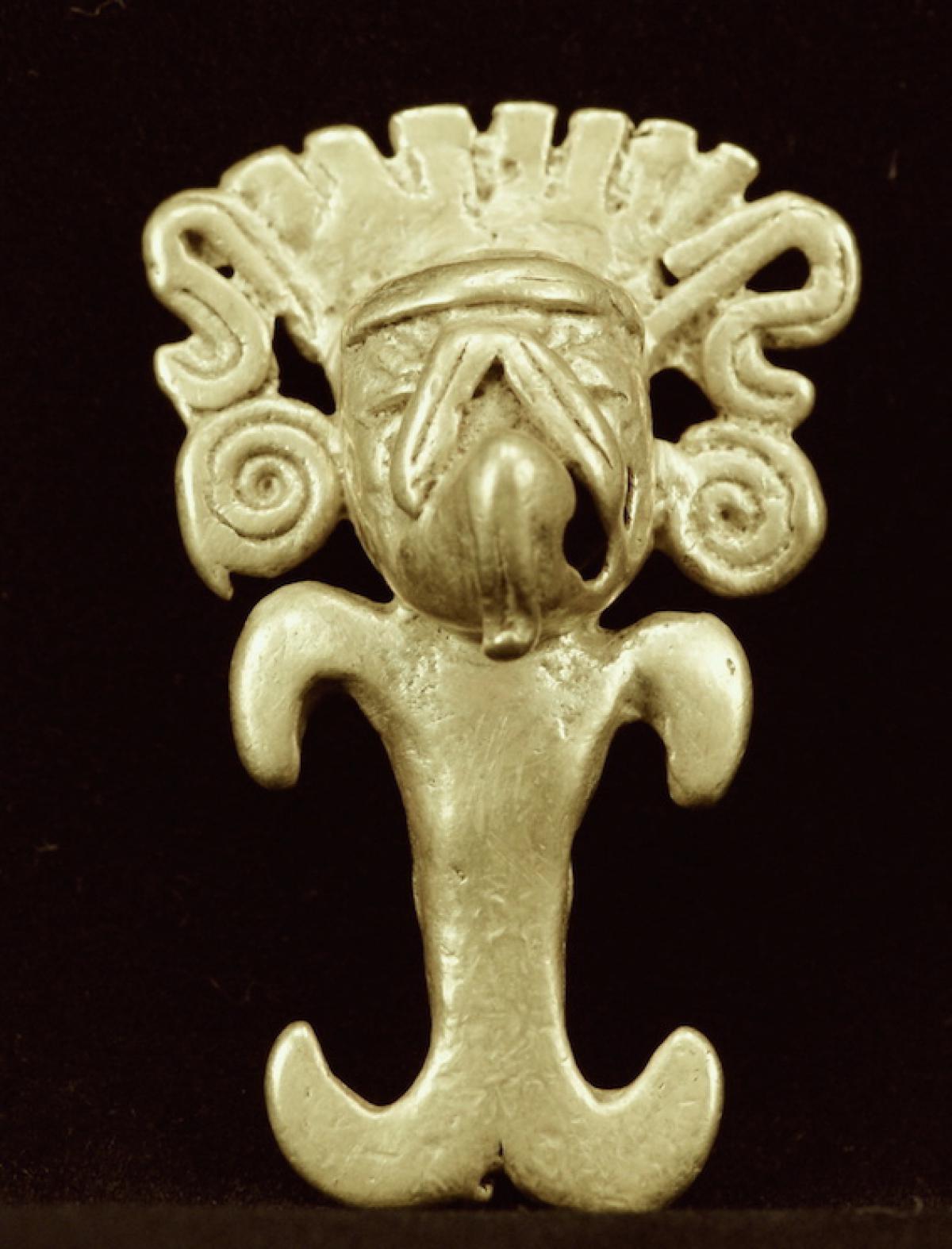
Cast gold figurative pendant. It represents a highly schematized crocodile whose head has been replaced by a human head, made with more detail, wearing a large headdress and facial paintings. A defect in the casting process of the piece has deformed its jaw in such a way that it is not possible to appreciate the features of the lower part of the face. On the back there is a ring at the height of the neck for suspension. International style.
It is not easy to describe the body of the figure if the most naturalistic models and intermediate stages of the style that lead to the schematization presented in this figure are not known. The original crocodile is now an elongated trunk at whose upper end two appendages, curved slightly inwards, represent the upper extremities; and at the lower end two other appendages, curved outwards, represent a bifurcated tail. The lower extremities of the animal, which similar figures have, are absent. The observable part of the human face is limited to the eyes, where deep longitudinal indentations mark the eyelids. From these, two double oblique bands branch upwards, which could be facial paintings. At the top of his forehead there is a double band. From the centre of this band hangs another, which at the height of the nose and covering it, splits into two other double bands that cross the cheeks. The latter can again be interpreted as facial paintings, although it could be part of the headdress that falls over the face. The head adornments combine spirals turning inwards that cover the ears, which is characteristic of the Quimbaya tradition, with a headdress in the Zenú tradition: Seven rectangular elements (possibly feathers) extend upwards, and at both ends two double bands extend upwards, fall down, and curve outwards.
Within the metallurgical group designated in the International Style area (A. D. 400-900), it belongs to category 3, crocodiles, type D, according to Bray´s classification (1992:34-40). A very similar figure with differences in head ornaments was found in tomb 32 of the Conte Site (Lothrop, 1937:165 Fig.151a).
MG.
It is not easy to describe the body of the figure if the most naturalistic models and intermediate stages of the style that lead to the schematization presented in this figure are not known. The original crocodile is now an elongated trunk at whose upper end two appendages, curved slightly inwards, represent the upper extremities; and at the lower end two other appendages, curved outwards, represent a bifurcated tail. The lower extremities of the animal, which similar figures have, are absent. The observable part of the human face is limited to the eyes, where deep longitudinal indentations mark the eyelids. From these, two double oblique bands branch upwards, which could be facial paintings. At the top of his forehead there is a double band. From the centre of this band hangs another, which at the height of the nose and covering it, splits into two other double bands that cross the cheeks. The latter can again be interpreted as facial paintings, although it could be part of the headdress that falls over the face. The head adornments combine spirals turning inwards that cover the ears, which is characteristic of the Quimbaya tradition, with a headdress in the Zenú tradition: Seven rectangular elements (possibly feathers) extend upwards, and at both ends two double bands extend upwards, fall down, and curve outwards.
Within the metallurgical group designated in the International Style area (A. D. 400-900), it belongs to category 3, crocodiles, type D, according to Bray´s classification (1992:34-40). A very similar figure with differences in head ornaments was found in tomb 32 of the Conte Site (Lothrop, 1937:165 Fig.151a).
MG.
Date of field recording:
18/03/2011
Excavation campaign:
2011
Record type:
Metal artifacts
Context-based browsing of El Caño repository
Archaeological site:
El Caño
Operation:
Operation 1
Stratigraphic group:
Tomb 6
Stratigraphic unit type:
Interment
Stratigraphic unit (finds):
125
Individual´s funerary attire:
I01
Calibrated Age Range:
Cal AD 775 to 790 (Cal BP 1175 to 1160)/Cal AD 800 to 980 (Cal BP 1150 to 970)
Finds-based browsing of El Caño repository
Artifacts
Metal artifacts:
Pendant
Measurements
Dimension 1:
height mm
=:
41
Dimension 2:
width mm
=:
26
Dimension 3:
thickness mm
Weight:
g
=:
16.8
Digital Object 955