


Digital Object 970
Description:
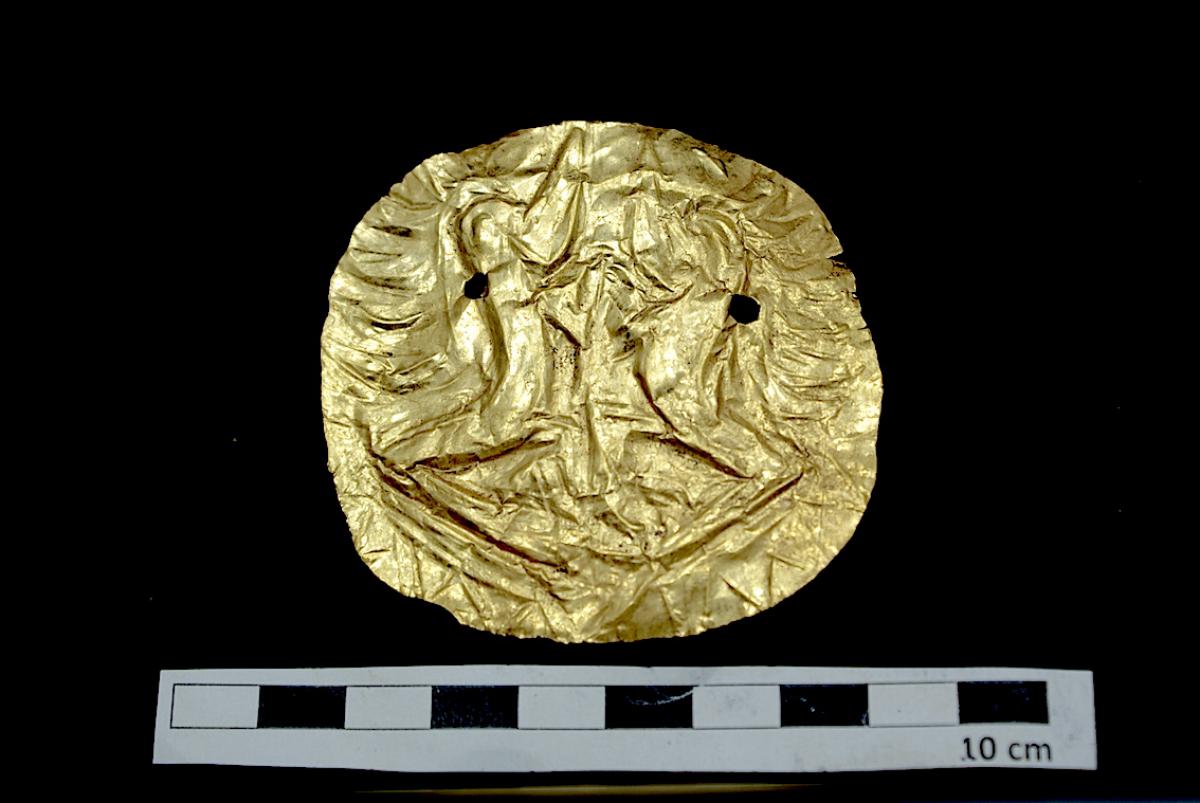
Hammered gold discoidal pectoral embossed with the mirror image of two supernatural hybrid beings of bird and reptile. It has two holes for suspension at the height of the eyes of the figures. Conte Style
Although the piece is very deteriorated it is possible to observe two quadrupeds in profile each with a bird´s head, from which a long crest emerges backwards following the line of the body; almond eyes; a long and wide beak; two short legs attached to the body with claws; and a long serrated tail that curves towards the central axis of the design. The crest is decorated with a curved pattern that can be identified as feathers, and the tail bears the pattern of triangles associated with reptiles. In both cases the patterns reach the rim of the pectoral. The image is organized with a specular symmetrical axial balance and delicately maintains the balance between the parts opposing the peaks with the end of the tails. The legs, claws and tails point to a crocodile, the crested bird with a long beak, which is difficult to identify, appears very frequently in the iconography of the style. The sky-earth duality (bird/reptile) that shows the hybridization of the figures becomes four when it is specularly duplicated. The concept represented in this pectoral is the same as that of one of the main individual (ID 523, registration number 9268), and another of those of individual I01 (ID 970, registration number 4756), of tomb T2.
MG.
This pectoral is part of a group consisting of three pectorals with registration numbers 9140 and 9128; four cuffs (9142, 9144, 9143 and 9130); two wooden ear rods (9145, 9146 and 9147); and a necklace of small green beads (9129). All these miniature grave goods were found in an articulated anatomical position although no bone remains were found. It is believed that this is due to the fact that the human bones of children, with hardly any calcium, and the environmental context in which the body was deposited—a high PH of the earth matrix together with the oscillation of seasonal humidity—made the organic remains of the burial disappear, with only the grave goods being conserved. It may also be the burial goods of a substitute artifact representing an infant.
JM
Although the piece is very deteriorated it is possible to observe two quadrupeds in profile each with a bird´s head, from which a long crest emerges backwards following the line of the body; almond eyes; a long and wide beak; two short legs attached to the body with claws; and a long serrated tail that curves towards the central axis of the design. The crest is decorated with a curved pattern that can be identified as feathers, and the tail bears the pattern of triangles associated with reptiles. In both cases the patterns reach the rim of the pectoral. The image is organized with a specular symmetrical axial balance and delicately maintains the balance between the parts opposing the peaks with the end of the tails. The legs, claws and tails point to a crocodile, the crested bird with a long beak, which is difficult to identify, appears very frequently in the iconography of the style. The sky-earth duality (bird/reptile) that shows the hybridization of the figures becomes four when it is specularly duplicated. The concept represented in this pectoral is the same as that of one of the main individual (ID 523, registration number 9268), and another of those of individual I01 (ID 970, registration number 4756), of tomb T2.
MG.
This pectoral is part of a group consisting of three pectorals with registration numbers 9140 and 9128; four cuffs (9142, 9144, 9143 and 9130); two wooden ear rods (9145, 9146 and 9147); and a necklace of small green beads (9129). All these miniature grave goods were found in an articulated anatomical position although no bone remains were found. It is believed that this is due to the fact that the human bones of children, with hardly any calcium, and the environmental context in which the body was deposited—a high PH of the earth matrix together with the oscillation of seasonal humidity—made the organic remains of the burial disappear, with only the grave goods being conserved. It may also be the burial goods of a substitute artifact representing an infant.
JM
Date of field recording:
27/03/2011
Excavation campaign:
2011
Record type:
Metal artifacts
Context-based browsing of El Caño repository
Archaeological site:
El Caño
Operation:
Operation 1
Stratigraphic group:
Tomb 2
Stratigraphic unit type:
Interment-offering
Stratigraphic unit (finds):
128
Individual´s funerary attire:
I20
Calibrated Age Range:
Cal AD 900 to 1020 (Cal BP 1050 to 930)
Finds-based browsing of El Caño repository
Artifacts
Metal artifacts:
Breastplate
Measurements
Dimension 1:
height mm
=:
63
Dimension 2:
Width mm
=:
67
Weight:
g
=:
2.8
Digital Object 970